
Newsletter Subscribe
Enter your email address below and subscribe to our newsletter
Enter your email address below and subscribe to our newsletter

 ByJohn A
For the modern postgraduate student in the United States, the true hurdle of a university degree isn’t a lack of information. It is the overwhelming stress of managing it all. Between compiling continuous streams of lab results, sorting through hundreds of PDFs, and attempting to outline a multi-chapter paper, the traditional writing process quickly hits a wall. When you are balancing tight deadlines with work or teaching obligations, staring at a blank document trying to turn massive spreadsheets into polished paragraphs feels incredibly daunting.
Surviving this digital deluge requires a change in strategy. Instead of working harder, successful graduate candidates are building an accessible, practical digital toolkit—a personal “tech stack” designed to save hours of frustration on their next thesis draft. This workflow isn’t reserved for computer scientists or data analysts; it is a straightforward, step-by-step approach to organizing your thoughts and protecting your sanity. For students hitting severe roadblocks during this transition, turning to dedicated external academic guidance resources can provide vital technical help with thesis organization, structural editing, and data presentation to help push a complex paper past the finish line.
By connecting a few smart digital tools, you can transform your computer from a chaotic folder of miscellaneous files into a seamless writing machine. This guide breaks down how to streamline your data, master your bibliography, and turn scattered research notes into a cohesive, high-impact draft.
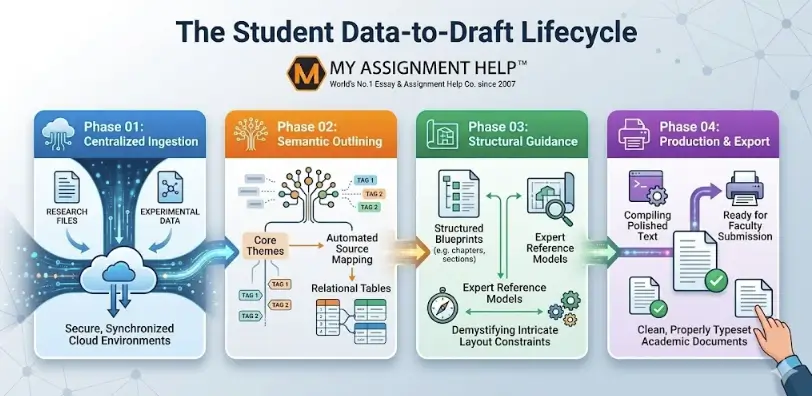
The foundation of a stress-free writing workflow is data custody. In the past, students manually copied data from external instruments, pasted it into standalone spreadsheets, and then re-typed those numbers into static document tables. This fractured process introduces easy transcription errors and makes it incredibly difficult to update your work if your primary findings change late in the semester.
Today’s smart workflow uses connected cloud folders to automate data tracking. By organizing your primary data matrices inside cloud-hosted computational spaces, your formulas and variables update dynamically. For example, if we represent your raw research data pool as a variable matrix, any analytical modification you perform can be programmatically linked straight to your document editor:
This ensures that whenever you adjust an underlying spreadsheet, every corresponding summary table and reference inside your working draft updates automatically. The writing process stops being a stressful post-mortem chore of manual data entry and becomes a smooth, real-time reflection of your active study.
Conducting a comprehensive literature review is often one of the most time-consuming parts of academic writing. A single library search can return thousands of essays, leaving students drowning in browser tabs and printouts. Trying to remember which paper contained a specific quote weeks after reading it causes massive delays.
To handle massive bibliographies, modern scholars use open-source reference managers connected to semantic visualization plugins. Tools like Zotero allow you to tag, sort, and map your reading material by sub-topic, method, or author. Instead of hunting through endless downloads, these programs let you build an interactive visual map of your sources, instantly revealing which papers are central to your field and which are merely tangential.
When it comes to drafting, these citation environments write your bibliography for you. As you write in your document editor, simple citation plugins pull reference data directly from your digital library, formatting your inline citations and final bibliography perfectly to APA, MLA, or Chicago styles. This removes manual formatting mistakes and ensures your references stay intact through every round of edits.
See also: How Smart Technology Improves Workplace Productivity
Even with a well-organized reference library, staring at a blank screen remains a major cognitive obstacle. For many undergraduate and early-stage graduate students, the real problem isn’t understanding the research, but knowing how to format it. Turning raw statistical analyses or qualitative interviews into a persuasive academic argument that satisfies strict institutional guidelines is a highly specialized skill.
When balancing tight deadlines against complex course requirements, struggling candidates find that using clear writing templates saves hours of trial and error. Analyzing high-scoring, peer-reviewed outlines helps you see exactly how to structure an abstract, lead into a literature review, and ground your discussion section. Within this space, leveraging structured drafting blueprints—such as those found via advanced academic assistance platforms—can dramatically demystify complex university rubrics for struggling candidates, providing verified models that make it much easier to organize original college papers and projects.
This strategy doesn’t bypass the hard work of research; it provides the scaffolding needed to showcase your findings clearly. Studying professional models helps you see how to weave evidence into your text, avoid writer’s block, and maintain academic rigor from introduction to conclusion.
There is nothing worse than losing pages of writing to a sudden system crash or a corrupted file. Relying on manual backups like saving files as “Draft_Version_2_Final_v3.docx” frequently leads to lost edits, mismatched files, and severe panic as deadlines approach.
To protect your hard work, integrate automated version tracking directly into your writing routine. Modern writing environments can log every change you make to a document in real time, saving a complete history of your edits securely. This gives you an absolute safety net: if you accidentally delete a paragraph or decide an old draft was stronger, you can roll back your file to any exact minute in the past.
This clear tracking changes the way collaborative student teams work together. Instead of passing confusing email attachments back and forth, multiple authors can write in separate sections of a shared document simultaneously. The system manages edits automatically, removing file conflicts and protecting your text through every iteration.
Updating your study habits isn’t just about finishing your current project faster; it is about building a better approach to long-term scholarship. By replacing slow, manual tasks with connected digital tools, university students can step away from administrative busywork and focus entirely on original thinking and deep analysis.
As university demands grow more intense, your ultimate academic success depends heavily on your digital organization and tactical flexibility. Incorporating automated backups, clear citation managers, and trusted educational support guides lets you handle your workload with absolute confidence. Ultimately, a well-balanced digital stack does more than just save you time—it gives you the freedom to write clear, impactful, and persuasive papers that truly reflect your potential.
Connected folders link your primary data files straight to your document editor. This means any change you make to an underlying chart or database automatically updates the corresponding tables inside your text draft. This eliminates the need to manually copy and paste numbers, protecting your paper from easy typos.
Yes, absolutely. Reviewing verified structural blueprints and high-scoring reference templates is a highly effective way to learn academic format. It helps you see how to properly frame arguments, layout complex data, and structure your text to meet difficult assignment rubrics.
Saving endless versions of a file (like “Final_Draft_v2”) creates massive clutter and makes it easy to lose your latest edits. Automated version control tracks changes in real time behind the scenes, letting you review your history or restore an earlier version safely without risking file corruption.
Dr. Evelyn Vance is a Senior Content Strategist and Academic Workflow Analyst at MyAssignmentHelp, specializing in the optimization of digital infrastructures for higher education. With over a decade of experience advising research candidates across the United States on dissertation design, computational methodologies, and structural development, her work focuses on bridging the gap between emerging educational technologies and traditional publication standards.
